

Indexes hit new highs driven by AI optimism— while rising interest rates and energy-driven inflation pressured bonds and non-AI stocks.. Here’s what transpired and the questions we’re carrying into the fourth quarter.
Key TakeawaysThe market narrowed sharply. The major indexes hit new highs despite weakness in September when roughly 80% of the companies in the S&P 500 Index fell, while the strength of a small group of AI companies pulled the market higher. Rising rates and inflation weighed on almost everything that wasn’t AI related. Higher interest rates and inflation pushed down bonds, utility stocks, and smaller company stocks. AI acts as an engine of growth and a source of risk. The AI boom lifting stock indexes has created the market’s biggest concentration of stocks, which represents a major opportunity for growth and a real vulnerability for falling prices at the same time. |
__________________________________________________________________
At first glance, the third quarter looked positive as the major stock indexes climbed to record highs. However, almost all of those gains came from a small group of companies tied to artificial intelligence, while the typical stock fell.
Interest rates also rose sharply, driven by inflation and an increasing amount of government debt, which pushed down the price of bonds and other steady, income-paying investments.
In the sections that follow, we look at each of these forces in turn, walk through how the different parts of the market performed, and share the questions we’re watching most closely as the year winds down.
Market Headlines
Rising Rates and a Mountain of Debt
Interest rates climbed sharply this year. The 10-Year Treasury — a key government rate that helps set the rate on mortgages and many other loans — rose from about 4.2% at the start of the year to roughly 5.3% at the end of the third quarter. Three things are pushing rates higher: inflation, the enormous borrowing fueling the AI buildout, and the federal government’s own growing debt.
That government debt is a big part of the story. U.S. debt has now passed $40 trillion — roughly 125% the size of the entire U.S. economy — and simply paying the interest on it costs more than $2 billion a day, the fastest-growing expense in the federal budget. To keep funding itself, the government has to sell more and more bonds, and investors are demanding a higher interest rate to absorb the debt.
Those higher rates show up throughout daily life, in things like 30-year mortgage rates over 7%, home-equity lines of credit in the mid-7% range, and added pressure on stock prices.
Interest rates and bond prices move inversely from one another. Rising rates can be a painful experience as bond prices fall, but this year has been far milder than 2022, the last time rates jumped dramatically. In 2022, we were in a low interest rate environment, and bond prices are much more sensitive to rate increases in low-rate environments. As a result, in 2022, the core U.S. bond market declined 14%. Interest rates started 2026 much higher compared to 2022, and as a result, bond prices have been much less sensitive to increases in interest rates. Through September, the core U.S. bond market has declined only about 3%.
How Energy Is Driving Inflation
A large part of the rise in inflation is due to the rise in energy prices. The ongoing conflict in Iran has kept much of the world’s oil bottled up in the region, and the effect shows up at the pump. The price of diesel fuel has nearly doubled the past nine months, from about $3.50/gallon to roughly $6.00/gallon. Because almost everything Americans buy travels by truck at some point, higher diesel prices gradually push up the cost of goods across the board. By September, overall inflation had risen to 3.7% compared with a year earlier.
The AI Boom and a Narrower Market
Despite pressure from rising rates and inflation, the major U.S. stock indexes climbed to new highs in the third quarter, almost entirely because of artificial intelligence optimism. Money has continuously poured into AI-related companies while investors grew cautious about bonds and almost anything else that isn’t AI-adjacent. Companies outside that sphere faced a tougher world of higher borrowing costs, higher fuel bills, and stiff competition from AI firms for both talent and equipment.
The strength of AI-related stock was on full display in September. Roughly 80% of the companies in the S&P 500 Index declined and the average stock dropped about 5%. Of the market’s eleven major sectors, only two rose, and the common thread among the winners was, once again, a connection to AI and the data centers being built to power it.
AI-related companies are not just impacting stock markets. Technology companies have historically been massive generators of free cash flow, wide profit margins, and big profits. Initially, the AI buildout was financed by these profits, but AI hyper scalers and data center builders have needed an expanding pool of money and have turned to debt markets to help finance the build out. AI-related borrowing is estimated to be $570 billion by year-end. This amount of debt financing, coupled with US government bond issuance, is adding to the total amount of bonds issued in 2026 and impacting interest rates, a theme this quarter.
What we have now is a market driven primarily by one theme which is good and bad. A market rally built on a single theme is more fragile than one powered by many themes, and that is worth keeping in mind even while the indexes are setting records.
How the Different Parts of the Market Performed
Here is how the major parts of the market did during the quarter and over the year so far, from the largest U.S. companies down to commodities like oil.
Total return by asset class, Q3 2026 vs YTD (index proxies)
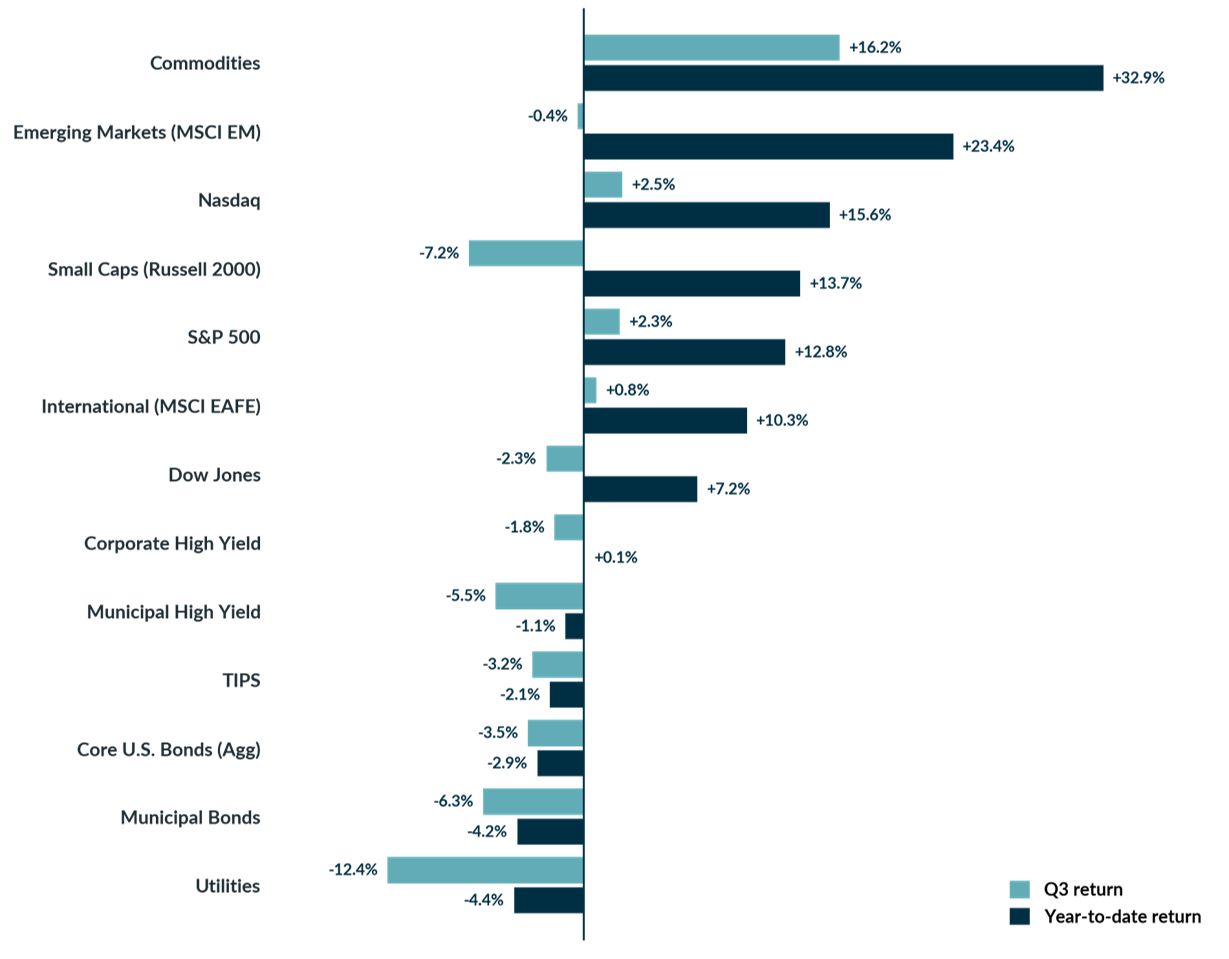
Data source: YCharts. Chart by The Next Level Planning Group. Index figures are not client returns. Past performance is not indicative of future results.
The Largest U.S. Companies
The largest U.S. companies managed gains as the S&P 500 rose 2.3% in the quarter and is up 12.8% for the year. The technology-heavy Nasdaq added 2.5% (up 15.6% for the year), while the Dow Jones fell 2.3%. Set the AI leaders aside, and the quarter looked much weaker than the headline numbers suggest.
Smaller Companies
Smaller U.S. companies had a rough quarter. Firms in the Russell 2000 index had been among the market’s leaders earlier in the year, but they fell 7.2% in the third quarter and gave back much of those earlier gains, though they remain up 13.7% for the year. Smaller companies tend to rely more heavily on borrowing, which makes them especially sensitive to interest rates, so the sharp rise in rates hit them hard.
International and Emerging Markets
Markets outside the United States cooled after a strong first half of the year. Developed international markets edged up 0.8% in the quarter and are up 10.3% for the year while emerging markets slipped slightly but still hold the strongest year-to-date return up 23.4%. Much of that strength traces back to the same AI boom, since many of the Asian companies that make the chips and equipment behind AI are part of those markets.
Utility Companies
Utility companies were the quarter’s worst performers, down 12.4% for the quarter and 4.4% for the year. The reason comes back to interest rates. Investors often buy utilities for their steady dividends, but when safe government bonds suddenly pay much higher rates, those dividends look less attractive by comparison, and money moves elsewhere. It was a sharp turnaround from earlier in the year, when utilities had been one of the market’s safer places to hide.
Bonds
Bonds, which many investors rely on for stability, also had a difficult quarter, largely because bond prices fall when interest rates rise. Core U.S. bonds fell 3.5% in the quarter (down 2.9% for the year), bonds issued by states and cities fell 6.4%, and inflation-protected government bonds lost 3.2%, with longer-term bonds hit hardest. There is a real silver lining, though, because bonds now pay higher interest than they did a few years ago, investors can expect more income from them going forward.
Commodities
Commodities were the standout of both the quarter and the year, powered by the same energy story driving inflation. Commodity prices jumped 16.2% in the quarter and are up a remarkable 32.9% for the year, by far the best of any category we track. Their strength is a useful reminder of why we include them in diversified portfolios: they often rise when stocks and bonds are struggling, which helps balance out the rest.
Two Questions on Our Minds
Beyond the numbers, a few questions are on our minds as we head into the final stretch of the year.
1. Are higher interest rates here to stay?
Our working assumption is that higher interest rates are likely to stay with us for a while. Rates could ease if oil prices fall and inflation cools, or if the job market, which already looks a little soft in white-collar fields, partly because of AI, weakens further. Working in the other direction, rates could stay high or climb higher if investors remain worried about the government’s growing amount of debt, or if the AI buildout keeps driving demand for more borrowing. Either way, higher rates have real consequences: mortgages and other loans stay expensive, and investments like bonds and utilities face pressure, while the upside is that safer, income-paying investments pay decent return. In practice, this environment has us leaning toward shorter-term bonds, Treasury bills, and fixed annuities, which hold up better when rates rise while still capturing today’s higher payouts.
2. How concerned should we be that the market has narrowed to AI?
This is one of the most important questions the recent data raises. When a small number of AI companies carry the whole market higher, the market becomes more fragile, and future returns will depend not only on how those AI companies perform, but on whether they can live up to the very high expectations already built into their prices. It is entirely possible for AI to succeed as a technology and for AI investments to still disappoint, simply because so much good news is already priced in. Our response is not to chase the trend or to run from it, but to stay diversified. For clients approaching retirement, a strong run like this can also be a good moment to revisit whether a more conservative investment mix makes sense, a choice that is easier to make now that safer investments are offering a meaningful return.
The Bottom Line
The third quarter showed a market pulling in two directions at once. On the surface, stock indexes reached new highs; underneath, rising interest rates and energy-driven inflation weighed on bonds, utilities, smaller companies, and the average stock, while a small group of AI companies did most of the lifting. Looking at the full year, commodities have been the standout performer, the largest U.S. companies have posted solid gains, and bonds have struggled against the steady climb in rates.
No single quarter tells us where things are headed. The questions we will carry into the rest of the year are the ones above: whether higher rates are here to stay and how much risk is hidden in a market so concentrated in AI. Through all of it, our approach stays the same — keep portfolios diversified, focus on what we can control, and keep the conversation going.
We publish this update to share how we’re currently reading the market. If you’d like to talk through what any of it means for your own portfolio, start a conversation with our team.